
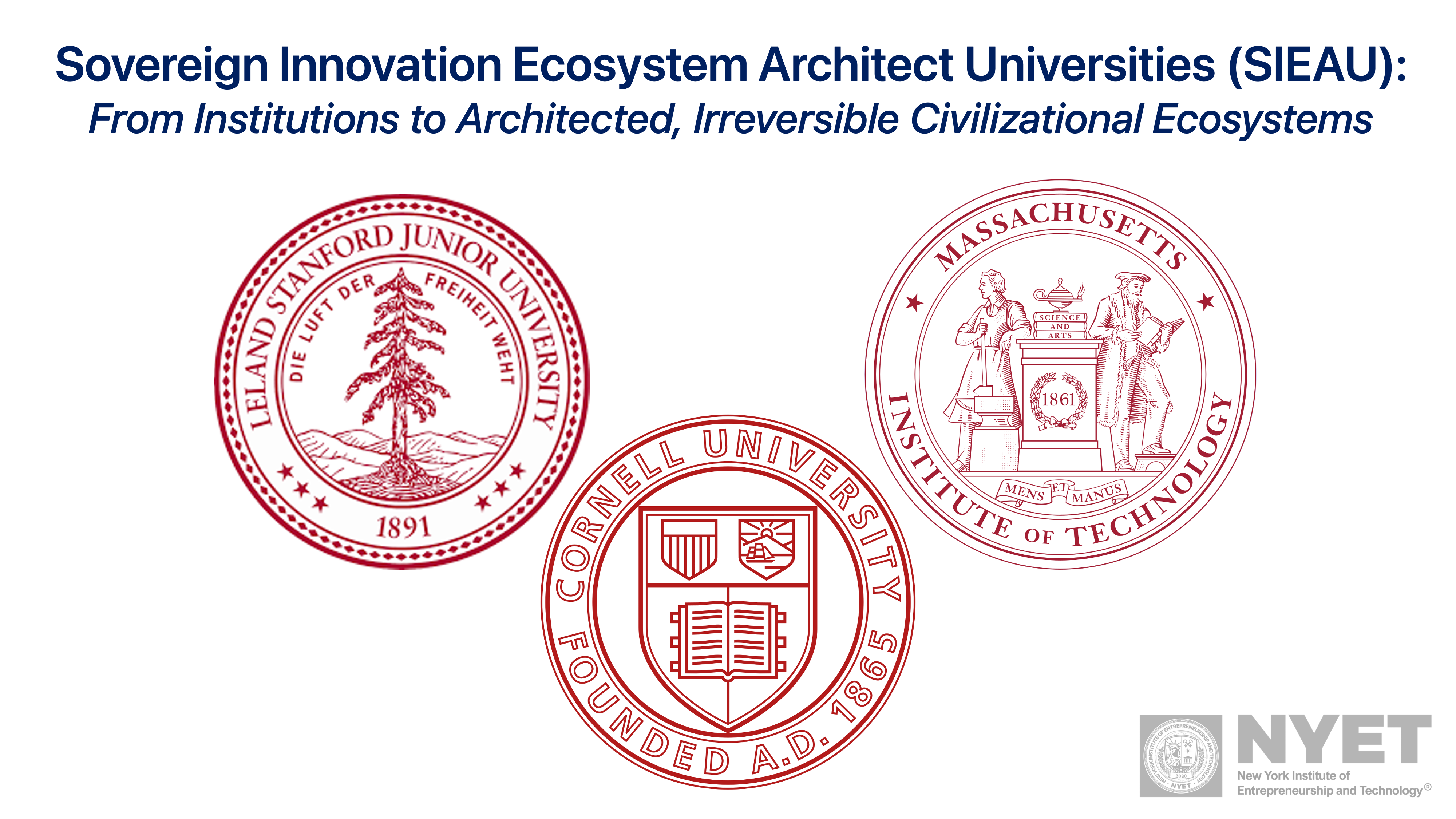
Sovereign Innovation Ecosystem Architect Universities (SIEAU)
From Institutions to Architected, Irreversible Civilizational Ecosystems
In the current phase of global competition, the university can no longer be adequately understood as an institution defined by teaching excellence, research output, or reputational hierarchy. A structural transformation is underway—one that repositions a select group of universities as sovereign ecosystem architects, rather than institutional participants.
This transformation is captured by the emergence of the Sovereign Innovation Ecosystem Architect University (SIEAU).
A SIEAU is not merely a high-performing university. It is a civilizational ecosystem architect—an entity that internalizes capital formation, knowledge production, talent circulation, and industrial deployment into a unified, recursively reinforcing architecture. Its defining attribute is sovereignty: the capacity to design the operating logic of an ecosystem, structurally condition the behavior of its participants, and progressively eliminate viable external alternatives.
I. Beyond Institutional Excellence: The Threshold of Sovereignty
Traditional universities—even the most elite—operate within externally structured environments. They supply talent, generate knowledge, and respond to market and policy signals. Their excellence is undeniable, yet their role remains derivative.
A SIEAU crosses a categorical threshold. It does not operate within an ecosystem; it architects the ecosystem itself.
This transition is structural rather than rhetorical, and is governed by four cumulative mechanisms:
- Path-Dependent Accumulation
Long-term concentration of intellectual capital, research capability, and institutional memory generates increasing returns that reinforce positional advantage. - Closed-Loop Capital Formation
Alumni capital, venture financing, and institutional investment are recursively reintegrated into university-originated ventures, forming an endogenous financial engine. - Switching Cost Escalation
Firms, researchers, and investors embedded within the ecosystem face progressively higher costs when attempting to exit, relocate, or replicate its structure. - Systemic Non-Substitutability
The ecosystem reaches a level of density and integration at which functional alternatives cease to exist at comparable scale or efficiency.
At this point, the university ceases to function as an institution. It becomes a sovereign ecosystem.
II. Architecture Over Participation: The Reconfiguration of Market Logic
The defining distinction between a SIEAU and a traditional elite university lies in the inversion of market positioning.
Traditional universities participate in markets.
SIEAUs architect markets.
This inversion is enabled by architectural sovereignty—the capacity to define standards, protocols, capital pathways, and talent flows across the ecosystem. In such systems, firms do not merely collaborate with the university; they operate within a structural logic designed by it.
This marks the transition from influence to structural control, and from participation to system design.
III. Established Sovereigns: Stanford and MIT
Stanford University and the Massachusetts Institute of Technology represent mature SIEAU configurations.
Their power is not reducible to academic prestige. It is grounded in the convergence of three interdependent layers:
- Capital Sovereignty
Alumni-driven venture ecosystems continuously recycle capital into university-originated ventures, reinforcing endogenous expansion. - Institutional–Industrial Fusion
The boundary between university and industry dissolves, producing a continuous innovation field in which research, entrepreneurship, and production co-evolve. - Irreversible Ecosystem Density
Silicon Valley and Kendall Square exhibit levels of concentration, interdependence, and path dependency that render replication prohibitively costly.
These universities no longer compete within innovation ecosystems.
They define the conditions under which innovation ecosystems operate.
IV. Emergent Sovereignty: Cornell and the Financial–Global Interface
Cornell University’s expansion through Cornell Tech in New York City represents a distinct trajectory: the construction of a financial–capital–anchored proto-SIEAU.
Its strategic logic lies in positional integration:
- Embedding within the world’s leading financial center
- Integrating academic production with venture formation and urban infrastructure
- Converging capital, talent, and data within a unified urban–global operational domain
Cornell, through its New York City and global expansion, represents an ecosystem in formation—not yet fully irreversible, yet structurally aligned with that trajectory.
It is not a completed sovereign ecosystem, but an emergent architecture approaching sovereignty.
V. Structural Incompleteness: High Capability Without Sovereignty
Many globally leading universities exhibit extraordinary capabilities yet fail to achieve sovereignty due to structural incompleteness.
Institutions such as UC Berkeley and UCLA demonstrate:
- world-class research output,
- deep talent concentration, and
- significant regional influence.
Yet their systems remain partially open:
- capital formation is not fully internalized,
- strategic cycles remain coupled to external governance regimes, and
- innovation outputs are frequently externalized into external corporate ecosystems.
These institutions occupy a partial sovereignty position—high capability without full ecosystem control.
VI. Excellence Without Sovereignty: Elite Private Institutions
Even among elite private universities, sovereignty is not guaranteed.
- University of Pennsylvania (UPenn)
Possesses substantial financial resources, yet capital flows remain globally distributed rather than recursively concentrated within a unified ecosystem. - Carnegie Mellon University (CMU)
A leader in artificial intelligence, yet its innovations are systematically absorbed into external technology platforms rather than retained within a university-governed ecosystem. - Johns Hopkins University (JHU)
Dominant in biomedical research, yet structurally embedded within federal funding architectures, limiting endogenous capital sovereignty.
These institutions are indispensable to global innovation.
However, they remain embedded within ecosystems they do not architect.
VII. The Architecture of Irreversibility
A SIEAU emerges only when three conditions converge into a unified system:
- Capital Sovereignty — endogenous, self-reinforcing financial circuits
- Architectural Sovereignty — control over ecosystem rules, standards, and coordination mechanisms
- Infrastructural Density — concentrated physical, digital, and organizational integration
When these conditions align, the ecosystem becomes irreversible.
Displacement is no longer a matter of competition.
It becomes systemically prohibitive.
VIII. Conclusion: The University as a Sovereign Civilizational Ecosystem
The rise of the SIEAU marks a fundamental reconfiguration of the university’s role in the global order.
The university is no longer a peripheral knowledge institution.
It is becoming a sovereign civilizational ecosystem—capable of designing, governing, and stabilizing entire configurations of innovation, capital, and industry.
This transformation is being accelerated by the emergence of AI-driven civilizational dynamics, in which the speed, scale, and recursive nature of knowledge production fundamentally exceed the capacities of traditional institutional models.
In this context, the legacy architecture of higher education—fragmented, linear, and externally dependent—is becoming structurally obsolete.
The university is becoming an integrated system of:
- capital formation,
- knowledge production,
- talent orchestration, and
- industrial deployment.
In this regime, excellence is insufficient.
What determines long-term dominance is the ability to:
- internalize capital flows,
- structure and govern knowledge production,
- architect ecosystem-level coordination, and
- enforce irreversible system dynamics.
Universities that fail to achieve this integration will remain highly capable participants within externally defined systems.
Those that succeed will not merely lead innovation.
They will design, govern, and stabilize the civilizational ecosystems that define the future.
By Dr. Young D. Lee
Principal, NYET – New York Institute of Entrepreneurship & Technology®
Author of Innovation Hegemony

 NYET - New York Institute of Entrepreneurship and Technology®