
The Irreversible Fifteen: Universities That Produced an Irreversible Civilization
Context
This article builds on the conceptual framework introduced in Innovation Hegemony (January 2, 2026), a book authored by Dr. Young D. Lee that examines irreversible civilizational corporations, universities, regions, and nation-states through emblematic cases such as NVIDIA, Stanford University, Silicon Valley, and the United States.
While corporate irreversibility is typically assessed through capital markets—and therefore discussed selectively—universities, largely outside direct capital valuation, allow for open, structural, and public analysis. This article accordingly focuses on irreversible civilizational universities within that broader theoretical framework.
Defining “Irreversible Civilizational Universities”
The term “Irreversible Civilizational Universities” refers to a small group of institutions that did not merely educate elites or advance scholarship, but produced, stabilized, and reproduced an irreversible form of modern civilization.
Here, irreversible civilization does not imply stasis or the absence of change. It refers to a civilizational condition in which core operating structures—standards, institutions, legitimacy hierarchies, knowledge regimes, technological pathways, and capital circuits—have become so deeply institutionalized that they cannot be meaningfully reversed or reconstituted elsewhere at comparable scale, speed, and institutional depth.
This irreversibility is observable through a recurring and verifiable set of mechanisms: durable credentialing systems, canon formation, standard-setting authority, professional closure, regulatory alignment, and capital–legitimacy circuits. Together, these mechanisms shift civilization from a field of competing possibilities into a path-dependent structural order.
Accordingly, an irreversible civilizational university is not defined by rank, prestige, or output metrics.
It is defined by structural agency—the sustained capacity to generate and entrench the institutional conditions under which modern civilization continues to operate.
From Academic Excellence to Civilizational Production
Universities are often described as competitors in a global market for talent, reputation, and research output. That framing is incomplete.
The institutions discussed here are not merely participants within an existing system. They are producers of the system itself.
Their civilizational role lies in their ability to originate and stabilize:
- regimes of knowledge validation (how truth, rigor, and credibility are institutionally determined),
- pathways for elite and professional reproduction (how governing, technical, and institutional elites are trained and circulated),
- standards and methods (what becomes normative in science, engineering, policy, and markets), and
- institutional linkages between knowledge, governance, and capital (how ideas become rules, and how rules become investable realities).
This is what distinguishes civilizational production from academic leadership. It is also how universities become structural makers of irreversibility, rather than competitive actors within reversible environments.
The Irreversible Fifteen: A Functional Map
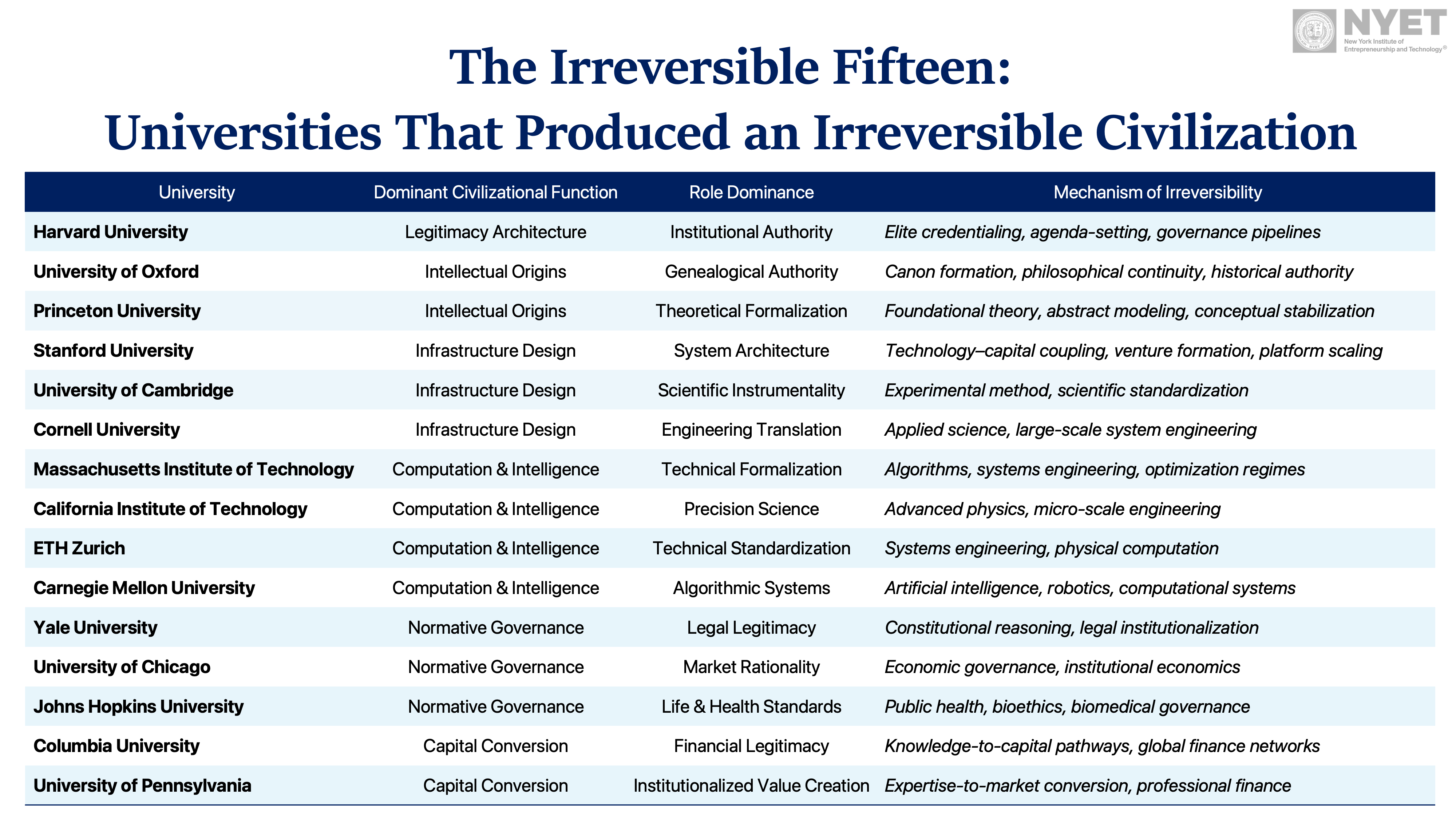
The Irreversible Fifteen should not be read as a ranking. It is a functional map of role dominance within modern civilization.
The functions below are analytically distinct but empirically interdependent. The purpose is not to isolate institutions into silos, but to identify where each university exercised decisive and disproportionate influence in producing an irreversible civilizational structure.
1. Legitimacy Architecture
Role Dominance: Institutional Authority
Harvard University
Harvard’s civilizational role lies in legitimacy production. Across governance, law, economics, diplomacy, and elite administration, it has functioned as a primary institutional arbiter of credibility and authority.
Through dense professional pipelines, agenda-setting networks, and institutional signaling, Harvard has helped define what the global system recognizes as institutionally valid. This form of legitimacy—once stabilized—constitutes a civilizational asset that is exceptionally resistant to replication at comparable depth.
2. Intellectual Origins and Canon Formation
Role Dominance: Genealogical Authority
University of Oxford; Princeton University
Oxford anchors the long historical continuity of Western philosophical, ethical, and intellectual traditions. Princeton has played a decisive role in formalizing high theory—mathematics, physics, economics, and political theory—through which modern rationality has been articulated.
Together, they exemplify universities that stabilized intellectual genealogies. Once canonized, these genealogies become structurally entrenched, marginalizing alternative lineages rather than competing with them on equal terms.
3. Infrastructure Design and Scalable Innovation
Role Dominance: System Architecture
Stanford University; University of Cambridge; Cornell University
Civilizational irreversibility emerges when knowledge is converted into infrastructure.
Stanford is institutionally coupled with the innovation architecture of Silicon Valley, where technology, venture capital, talent mobility, and commercialization pathways reinforce one another. Cambridge represents the institutionalization of experimental science and method as global standards. Cornell has translated scientific knowledge into engineered systems across physical and digital domains.
These universities exercised role dominance in establishing infrastructure pathways that later actors were compelled to adopt rather than redesign.
4. Computation and the Formalization of Intelligence
Role Dominance: Technical Formalization
Massachusetts Institute of Technology; California Institute of Technology; ETH Zurich; Carnegie Mellon University
These institutions constitute the civilizational core of computation and formalization. They defined how intelligence is encoded into algorithms, systems, optimization regimes, robotics, advanced physics, and large-scale engineering.
Here, intelligence is not a concept but a reproducible capability, sustained through high-density talent pipelines, technical infrastructure, and rigorous methodological standards. Such paradigms are cumulative, rendering comparable replication without decades of institutional investment highly improbable.
5. Normative Governance
Role Dominance: Boundary Setting
Yale University; University of Chicago; Johns Hopkins University
Civilization becomes irreversible not only through capability, but through limits.
Yale has shaped legal legitimacy and constitutional reasoning. The University of Chicago has exercised decisive influence over market rationality and institutional economics. Johns Hopkins has anchored global standards in life sciences, public health, and bioethical governance.
Once embedded in professional training, regulatory regimes, and institutional practice, these normative systems function as durable civilizational constraints rather than adjustable preferences.
6. Capital Conversion
Role Dominance: Institutionalized Value Transformation
Columbia University; University of Pennsylvania
Modern civilization attains structural fixation when intelligence can be reliably converted into capital and market legitimacy.
Columbia and Penn operate at the nexus of global finance, professional formation, and elite institutional networks. Their role dominance lies in institutionalizing pathways through which expertise becomes assets, markets, and durable capital structures—networks layered over time and resistant to external reconstruction at comparable institutional depth.
Complete List: The Irreversible Fifteen
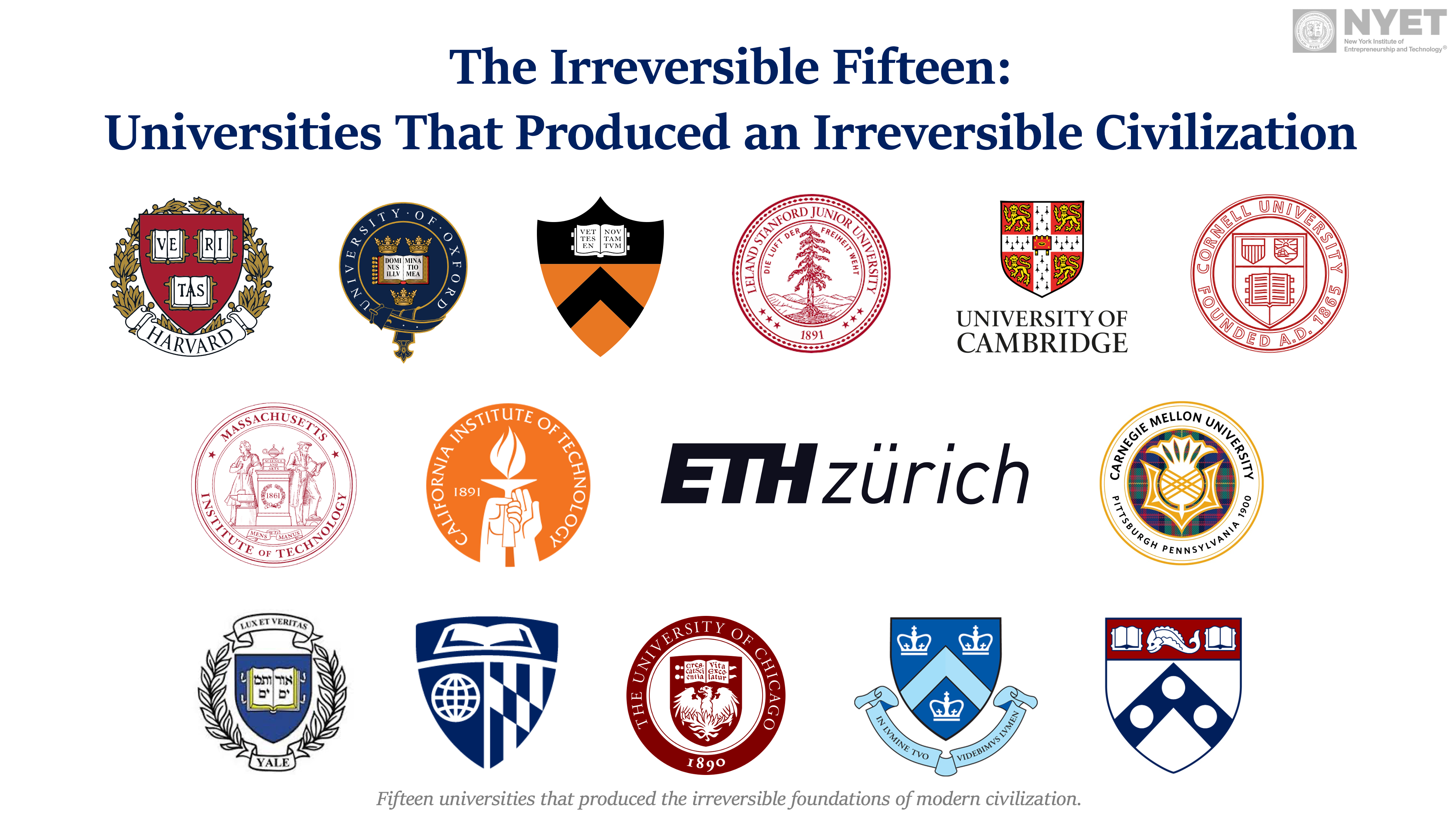
Harvard; Oxford; Princeton; Stanford; Cambridge; Cornell; MIT; Caltech; ETH Zurich; Carnegie Mellon; Yale; University of Chicago; Johns Hopkins; Columbia; University of Pennsylvania.
Why the Irreversible Fifteen Matter
The Irreversible Fifteen are not “the best universities.”
They are universities that produced the durable operating structures of the modern world—the institutional configurations that determine what becomes legitimate, scalable, governable, and investable.
Corporations may rise and fall. Technologies may be disrupted. Yet civilization’s deeper trajectory is shaped by whether its foundational institutional structures persist—and by who has the capacity to produce and stabilize them.
Understanding irreversible civilizational universities is therefore not an academic exercise. It is a strategic prerequisite for corporations, financial institutions, academic leaders, and governments seeking to understand how the modern world is institutionally produced—and why its hierarchies increasingly resist reversal.
About NYET
The New York Institute of Entrepreneurship and Technology (NYET) is a global think tank and strategic powerhouse dedicated to advancing innovation, entrepreneurship, and institutional leadership within the U.S. and global innovation ecosystems.
Positioned at the intersection of strategy, policy, talent, technology, capital, and markets, NYET equips corporations, financial institutions, academic leaders, and governments with high-level strategic intelligence and execution capabilities to navigate complexity, shape institutional outcomes, and achieve durable global impact.
By integrating rigorous theoretical analysis with execution-oriented strategy, NYET bridges insight and action—enabling organizations not merely to respond to systemic change, but to architect and lead within it.

 NYET - New York Institute of Entrepreneurship and Technology®